There’s a number making the rounds in mobile marketing circles right now that deserves more attention than it’s getting.
Top-performing advertisers, the ones spending $4 million or more per quarter on UA, produced between 2,400 and 2,600 creative variations in 2025. That’s per quarter. And that number is up 25 to 30 percent from the year before.
Let that settle for a second.
If you’re a founder or growth leader looking at those numbers and thinking your team needs to produce more creative to compete, you’re not wrong. But you’re also only seeing half the picture. Because every other team in your category is looking at the same data and drawing the same conclusion. The result is a market where ad impressions jumped 20 percent in 2025 while the total audience barely moved. More ads. Same humans. Shrinking attention.
AI solved the production problem and created a bigger one in the process.
For years, the constraint on creative testing was production. You had a limited number of concepts you could afford to make, which meant a limited number of tests, which meant slow learning loops and a small stable of ads carrying all the weight.
AI collapsed that constraint. Generative tools cut the cost per creative variant by an estimated 60 to 75 percent. Teams that used to ship 20 concepts a month can now ship 200. The production bottleneck, for many teams, is effectively gone.
But here’s the problem. The attention ceiling is real, and it isn’t moving. There are only so many users, only so many sessions, only so many moments where someone might actually stop and watch your ad. Flooding those moments with more volume doesn’t expand the pool. It just makes the competition for each impression more intense.
The edge in 2026 is knowing which creative is worth making before you make it.
Ad fatigue typically sets in after five to seven exposures to the same creative. By the fourth repeat exposure, conversion rates drop roughly 45 percent according to Meta’s own research. The median creative refresh cycle in mobile marketing dropped from nine days in 2025 to just three days in 2026.
Three days.
That means the creative your team is proud of today has a functional shelf life measured in days, not weeks. And in a market where your competitors are all running high-volume pipelines, audiences are cycling through creative exposure faster than most production workflows can keep up with.
The math on this matters for founders specifically because it reframes where your investment is actually going. If you’re spending on media, but your creative is fatiguing at three days and your refresh cycle is two weeks, you’re effectively wasting a meaningful percentage of your media budget running tired ads to a saturated audience. No amount of bidding optimization fixes that. It’s a creative operations problem, not a campaign management problem.
Here’s what separates the teams actually benefiting from high creative output from the ones just producing more of the same thing.
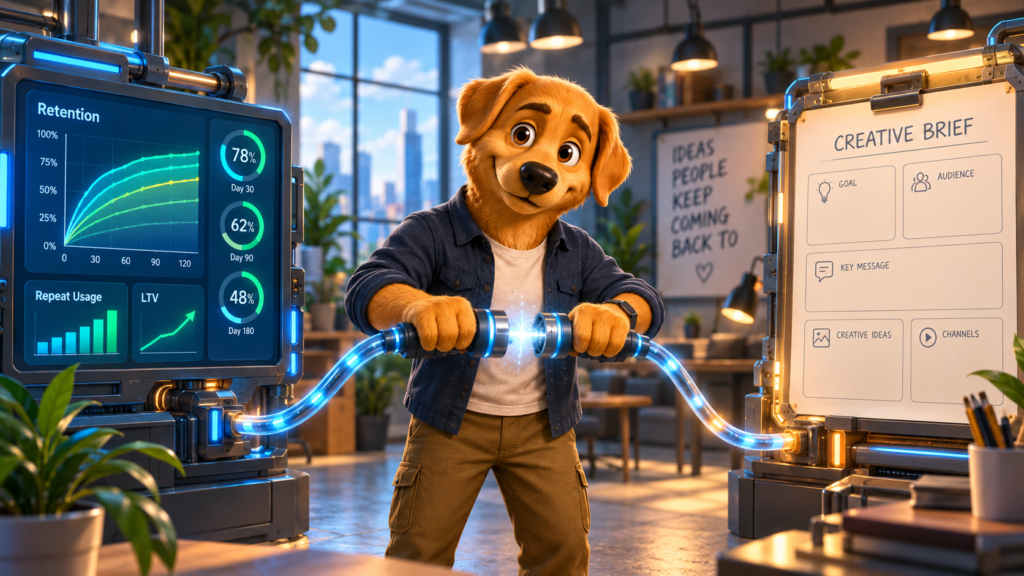
The teams benefiting have systems. They know what a winning concept looks like before it scales, because they’ve built testing processes that give them that signal early. They’re not guessing which of their 200 variants is going to perform. They’re running structured tests with clear hypotheses, reading the data at the concept level, and feeding those learnings back into the next production cycle.
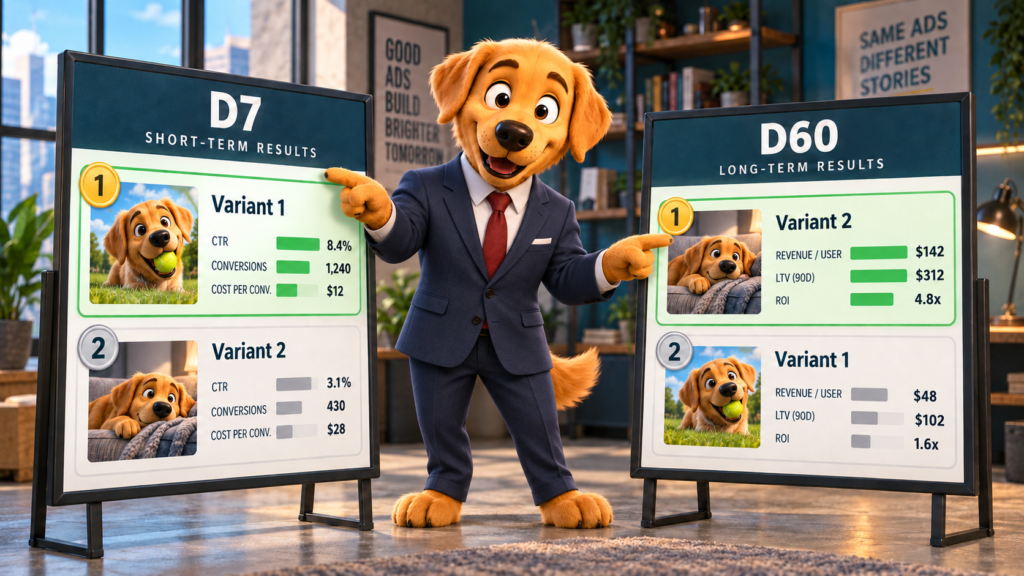
The teams just producing volume are doing something that looks like testing but isn’t. They’re launching a lot of creative, watching top-line metrics, and calling the ones with better CTR winners. That’s not a learning loop. That’s a leaderboard. And a leaderboard tells you what won without telling you why, which means you can’t replicate it or build on it.
The “why” is where the compounding advantage lives.
When you understand why a concept worked, whether it was the hook, the visual style, the emotional frame, the pacing, or the offer, you can apply that understanding systematically across the next round of production. Your creative gets better over time because each test teaches you something you carry forward. Without that, you’re starting from scratch every three days.
There’s a downstream effect of creative inflation that most teams aren’t accounting for yet.
When every app in your category is running high volumes of AI-assisted creative that’s all been optimized toward similar performance signals, the ads start to look alike. The hooks converge. The visual styles blur together. Users who’ve been through acquisition funnels before get faster at recognizing and filtering the pattern.
This is why brand identity is quietly becoming one of the more important differentiators in paid acquisition, not just in brand marketing. In a sea of content that’s increasingly optimized to be attention-grabbing, the creative that actually registers and sticks is the creative that feels distinct. It has a point of view. It has a visual language that’s recognizable across exposures. It builds something cumulative with each impression instead of starting from zero every time.
For founders, this is an argument for investing in what your creative actually looks and feels like, not just what it says. The teams treating creative as a pure performance function, A/B testing isolated variables in a vacuum, are missing the brand-building work that makes performance creative more effective over time.
High-performing teams in 2026 are shipping 80 to 120 creative variants per channel per month. That sounds like a lot until you understand the structure behind it.
It’s not 80 completely different ideas. It’s a smaller set of validated concepts explored across multiple formats, hooks, lengths, and visual treatments. The concept-level diversity is deliberate. The variation within each concept is systematic. And the testing is organized around learning questions, not just performance ranking.
This is the difference between creative velocity and creative chaos. Velocity means you’re moving fast with a clear direction. Chaos means you’re producing a lot and hoping something lands.
The structure looks roughly like this. You generate a range of distinct creative concepts, maybe eight to twelve in a given cycle. You test each one at modest spend to get directional signal. The ones that show early promise get iterated on aggressively, new hooks, new formats, new cuts. The ones that don’t get retired quickly. The learnings from both inform the next cycle.
Simple in theory. Surprisingly hard to execute without the right process and the right people running it.
The question isn’t whether to produce more creative. In 2026, you almost certainly need to.
If you want to talk through where your creative operation stands and what it would take to build the kind of velocity that actually moves the needle, that’s exactly the kind of conversation the Work Dog team is built for.