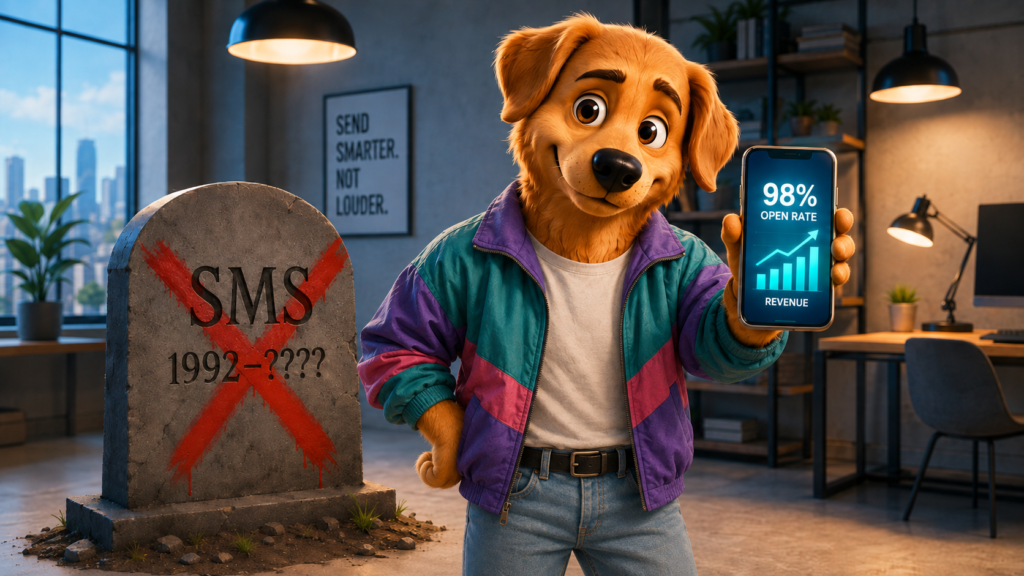
Every couple of years, someone declares SMS marketing dead. It is too old, too simple, too 2010. Email is smarter, push is free, and the cool channels are wherever the newest platform happens to be. Texting people feels like a relic.
The data thinks that is hilarious. SMS marketing is not just alive in 2026; it quietly posts engagement numbers that every other channel would trade almost anything for, and most brands are barely using it.
Start with the headline number. SMS marketing delivers a 98% open rate, with the majority of messages read within three minutes of delivery. Email, the channel everyone treats as the serious owned-channel workhorse, sits around 20%. The gap is not a few points. It is the difference between a message that gets seen and a message that gets buried. And that near-perfect visibility translates into response and conversion numbers that look almost made up next to the rest of the funnel.
Here is what the data actually says, from the media buying chair and the creative chair, because SMS is one of the few channels where those two roles collapse into a single, unusually direct conversation with your customer.
The case that SMS marketing is dead falls apart on contact with the benchmarks.
SMS maintains a 19% click-through rate and a 45% conversion rate on well-run programs, per Adjust and multiple 2026 benchmark studies. Email click-through rates, by comparison, generally sit between 1% and 4%. On raw response metrics, SMS marketing outperforms every other owned channel, and it is not close. Conversion rates in well-optimized programs range from the low 20s to the mid 30s in percentage terms, against low single digits for most other channels.
Then there is the return. ROI estimates place SMS marketing returns between $21 and $41 for every $1 spent, with strong programs and seasonal peaks reporting figures as high as $71 per dollar. Subscriber acquisition costs can run as low as $0.45. For a channel that was supposedly dead, that is a remarkably healthy set of vital signs.
Adoption backs it up. By 2025, roughly 84% of consumers had opted in to receive texts from at least one business, up from around 70% a few years earlier. Opt-out rates consistently sit below 3%. People are not tolerating branded SMS. They are signing up for it and staying. The global A2P messaging market that carries all of this was valued in the tens of billions and is still growing.
The myth that SMS marketing is dead is not just wrong. It is backward. The channel is one of the highest-performing owned assets available, and its biggest problem is that too few brands take it seriously enough to use it well.
From the UA and growth chair, the most important thing about SMS marketing is that it is owned, and owned looks better every year that paid gets more expensive.
Every blog in this series has circled the same pressure. Rising CPIs, compressing margins, install costs climbing faster than the revenue those installs generate. In that environment, a channel where you already have permission to reach the customer directly, at a $0.45 acquisition cost and a return measured in multiples of 20x or more, is not a nice-to-have. It is a pressure valve on your entire paid economics.
The strategic move is to treat SMS marketing as the retention and monetization engine that sits underneath your paid acquisition. You spend to acquire the user through paid channels. You capture the opt-in and shift the ongoing relationship to a channel that costs almost nothing to operate and converts better than anything you are buying. The expensive part is acquiring the customer once. SMS is how you monetize them repeatedly without paying the auction again each time.
This reframes what SMS is for. It is not a standalone campaign you run occasionally. It is the owned layer that raises the lifetime value of every user your paid channels bring in, which in turn raises how much you can afford to bid to acquire them. A strong SMS program quietly improves your paid unit economics by making each acquired user worth more. That is the connection most teams miss, because SMS lives with the retention team and paid lives with the acquisition team, and nobody does the math across the two.
The one hard rule from the buying side is compliance. SMS is powerful precisely because it is intimate, and strict opt-in rules and consumer sensitivity to frequency govern that intimacy. Every message is a high-stakes interaction. Abuse the channel and the opt-outs spike, the carriers throttle you, and the goose stops laying. Respect it, and it is the most efficient owned channel you have.
From the creative chair, SMS marketing is the most brutally honest creative discipline there is. You have around 160 characters, no visuals on a standard send, no production budget to hide behind, and a customer who will read the whole thing within three minutes. Every word has to earn its place.
That constraint is exactly why it is such good creative training and such a revealing test of whether a brand actually knows its own value proposition. A 30-second video ad can lean on spectacle and motion to paper over a weak idea. An SMS cannot. If the offer is not clear, the timing is not right, and the reason to act is not immediate, the message fails, and it fails in front of a customer who chose to hear from you. There is nowhere to hide.
The data on what works is specific. Personalization is the decisive factor, with personalized sends materially outperforming generic broadcasts on both open and conversion. Timing and relevance drive the whole outcome, since a perfectly written message sent at the wrong moment to the wrong segment still misses. Interactive formats like polls and two-way SMS convert dramatically higher than static blasts, because they turn a broadcast into a conversation. And A/B testing the specific elements- the CTA, the timing, the offer framing- can lift conversion rates meaningfully, which means SMS rewards the same testing discipline that governs good paid creative.
There is a format shift worth watching here too. RCS, the carrier-supported successor to SMS, now has cross-platform reach after Apple enabled interoperability, and it brings verified sender branding, rich cards, and product carousels into the messaging channel. It is not ready to replace SMS programs yet, but it is the direction the channel is heading, and it will reward brands that already have the creative discipline SMS demands.
SMS marketing is one of the rare channels where the media decision and the creative decision are almost the same decision, which is exactly why it gets neglected.
Paid social has a clean division of labor. The media team runs the buying, the creative team makes the ads, and the two hand off to each other. SMS does not split that way. The person deciding who gets the message, when they get it, and how often is making a media call and a creative call in the same breath, because in a 160-character message the targeting and the copy are inseparable. A perfectly segmented send with a weak message fails, and a brilliant message sent to the wrong list at the wrong time fails, and there is no separate team to blame because it is all one motion.
That is why SMS marketing tends to fall through the cracks at organizations built around the paid social division of labor. It does not fit the org chart. It needs someone who thinks about audience, timing, offer, and copy as a single integrated problem, which is the same integrated thinking that separates strong creative-and-UA operations from siloed ones generally. Teams that already run creative and media as one motion take to SMS naturally, because SMS is that philosophy compressed into its purest form. Teams that keep the two functions apart tend to underuse the highest-ROI owned channel they have, simply because no one owns the whole message.
SMS marketing is not dead. It posts a 98% open rate, a 45% conversion rate on strong programs, and returns that run from 20x to past 70x per dollar spent, and 84% of consumers have already opted in to hear from brands they like. Declaring it dead is one of the more expensive pieces of conventional wisdom in marketing, because it talks teams out of the highest-ROI owned channel available.
The growth move is to treat SMS as the owned layer that monetizes your paid-acquired users repeatedly and quietly improves your entire paid economics. The creative move is to respect the discipline of 160 honest characters and test them the way you test any high-value creative. And the reason SMS gets neglected is that it collapses the media and creative decision into one, which does not fit the way most teams are organized, and which is exactly why the teams that think in an integrated way win with it.
If you are sitting on an email list and a paid budget but no serious SMS program, you are leaving your most efficient owned channel on the table. Reach out and let’s get into it.