Something fundamental shifted in mobile UA over the last three years and most teams are still catching up to it.
The algorithmic side of user acquisition, bid optimization, audience targeting, budget pacing, has been largely absorbed by the ad networks themselves. Meta’s Andromeda, Google’s AI-powered App Campaigns, and TikTok’s Symphony now optimize audiences and bids at a speed and scale no human team can match. That shift left creative and measurement as the only two controllable levers UA teams still own.
Read that again. In 2026, creative is one of two things a UA team can actually control. And yet most teams are still structured as though media buying is the primary job.
A 2026 Meta internal study found that creative now accounts for roughly 56% of incremental app installs, more than audience targeting or bid strategy combined. Separate research puts creative elements responsible for 70 to 75% of overall campaign performance.
Top-quartile campaigns refresh creatives at least weekly, and top advertisers are producing 2,400 to 2,600 creative variations per quarter. UA managers who are not producing 15 to 30 new creatives per month at the scaling phase are already behind. Work Dog’s creative testing methodology was built around exactly this reality.
The teams hitting those numbers are not doing it through brute force. They are doing it through structure. Specifically, a creative-to-campaign loop where production, testing, learning, and iteration run as one continuous system rather than as separate workstreams that hand off to each other.
Most UA teams are set up linearly. Creative gets briefed, produced, handed to the media buyer, launched, and evaluated. If something works, more gets made like it. If something does not, a new brief goes back to creative.
That model is too slow for a market where the median creative lifecycle is three days and where platform algorithms are making real-time optimization decisions that your creative needs to keep up with.
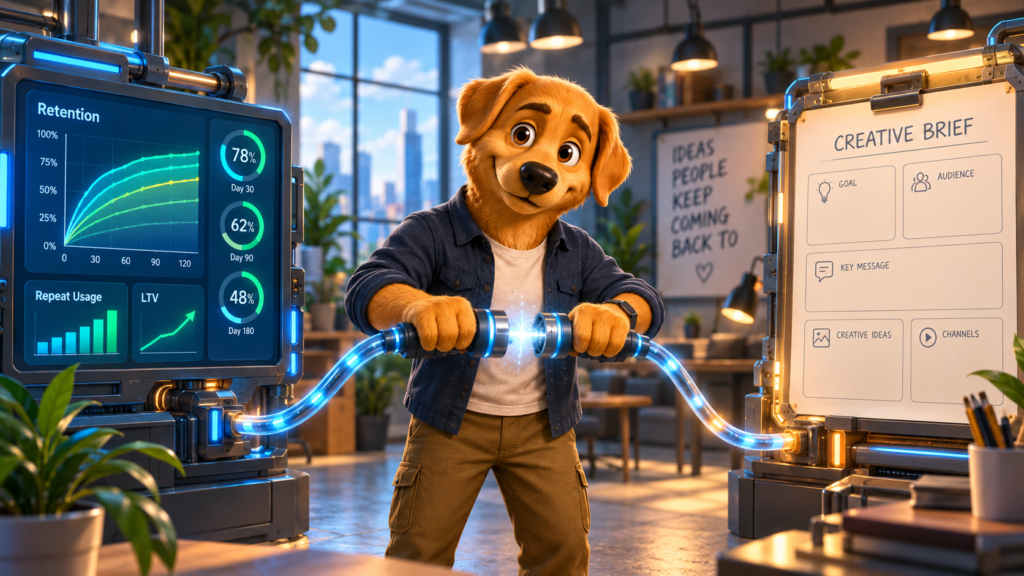
The loop model runs differently. Creative strategy, production, testing, and media buying are connected in real time. The brief informs the test structure. The test structure informs the spend. The performance data feeds directly back into the next brief. Nobody is waiting on a handoff because there are no handoffs.
The creative testing framework also varies by channel. On Meta, IPM-based testing in tier-4 countries is standard before rolling winners into tier-1 AEO campaigns. On AppLovin, new creatives are added to BAU campaigns every one to two weeks. On TikTok, two to three new ad sets with fresh creatives per week is the minimum cadence to stay competitive.
That kind of channel-specific cadence requires creative and media to be operating from the same playbook at the same time. Teams where creative and media buying sit in separate lanes, reporting to different people, operating on different timelines, cannot sustain that cadence.
Here is what the silo version looks like in practice, and it is more common than most teams want to admit.
Creative team produces assets based on brand guidelines and past performance intuition. Media buyer launches them across channels. Performance data lives in the media buyer’s dashboard. Creative team gets a summary two weeks later. New brief goes out. Repeat.
In that model, the feedback loop takes weeks. Creative decisions are made on stale data. The media buyer is optimizing around creative constraints they had no hand in setting. And when performance drops, the blame tends to move between teams rather than landing on the structural problem that caused it.
Teams using creative intelligence often see a 50% ROAS improvement by doubling down on proven patterns rather than guessing. Manual tagging and spreadsheet management are the biggest time sinks for UA teams, with automated workflows saving up to 20 hours per week per app.
The efficiency gains from integrating creative production and media buying are not marginal. They compound. Every cycle where creative learns from real performance data produces better inputs for the next cycle. Teams running siloed operations are not just slower. They are getting dumber over time relative to teams running integrated loops.
Structural integration between creative and UA does not happen by putting both teams in the same Slack channel. It requires shared goals, shared data, and shared decision-making authority.
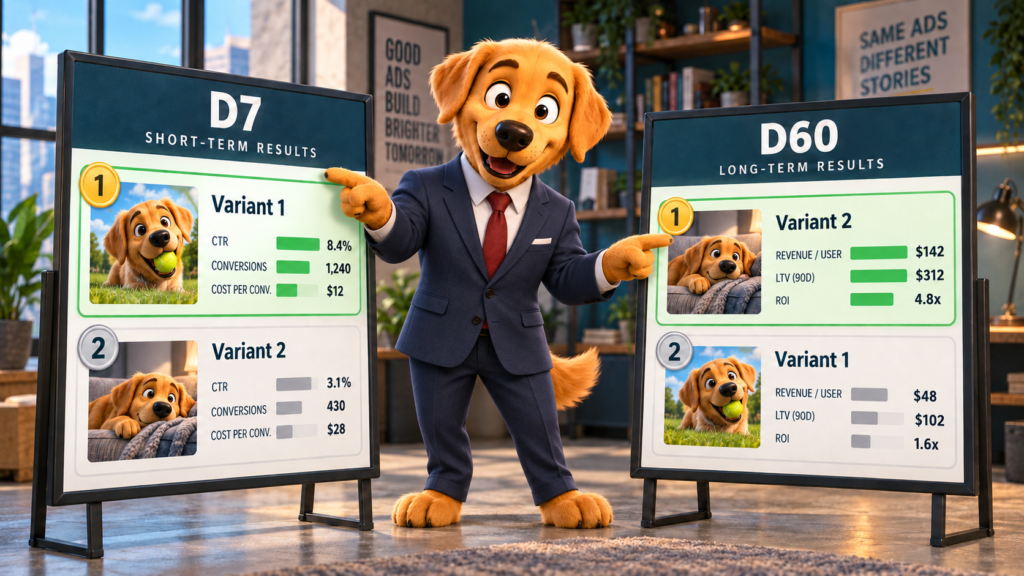
Shared goals. Creative teams optimizing for aesthetic quality and media teams optimizing for ROAS are pulling in different directions. The goal needs to be defined at the campaign level, not the team level. What does a winning creative look like in terms of downstream user behavior, not just click-through rate?
Shared data. Creative intelligence provides a single source of truth. UA teams and creative teams no longer argue over which ad looks better because they look at the same data-backed intelligence to see which elements are actually resonating with the audience. When both teams are working from the same performance signals, creative decisions become faster and more defensible.
Shared cadence. The creative brief cycle and the campaign planning cycle need to run on the same timeline. A media buyer planning channel spend for the next two weeks needs to know what creative will be available and when. A creative team building new concepts needs to know what the media buyer is seeing in the current rotation.
One of the most underrated structural improvements a UA team can make is investing in better creative briefs.
Most briefs describe what to make. Strong briefs describe why, for whom, on which platform, with what hypothesis, and against what benchmark. That level of specificity does not slow production down. It accelerates it, because the creative team is solving a defined problem rather than interpreting a vague request.
Before launching any creative testing cell, teams should write a clear hypothesis that can be proved or disproved. Selecting exactly which creative variation belongs in each test cell is what separates systematic testing from guessing.
A brief built around a testable hypothesis produces creative that teaches you something regardless of whether it wins or loses. A brief built around aesthetic preferences produces creative that either performs or does not, without telling you why.
The integrated creative-to-campaign model is exactly how Work Dog Studios is built to operate. Creative development and media buying run together as one program, which means the brief, the production, the test structure, and the campaign management are all connected from day one.
There is no handoff delay. There is no translation layer between what the creative team made and what the media team needs. The feedback loop is immediate because the teams are the same team.
For brands running creative production and UA through separate vendors or separate internal teams, that gap is costing real performance every cycle.
If you want to see what the integrated model looks like in practice for your specific program, reach out to the Work Dog team and let’s walk through it.
The ad networks have taken over the algorithmic side of UA. That means creative and measurement are the two things growth teams still control. The teams structured to move creative from brief to test to iteration faster than their competitors are the ones compounding their advantage. Speed without structure produces volume. Speed with structure produces learning. Learning is what scales.