The creative vs targeting debate used to have an obvious answer. For most of the last decade, the team with the sharpest audience segments won. You built lookalikes, layered interest stacks, carved out custom audiences, and the buyer who targeted best took home the lowest CPI. Targeting was the craft. Creative was the thing you handed off to the design team once the real work was done.
That world is gone, and the data on how thoroughly it is gone should reset how you think about where your effort goes. In 2026, the creative vs targeting question has flipped so completely that over-investing in targeting now actively hurts you. Here is what the numbers actually say, from both the media buying chair and the creative chair, because this is one of those shifts where the two are really the same story.
The mechanics are worth being precise about, because the shift is structural rather than a matter of opinion.
Control over targeting and bid optimization has shifted from the buyer’s hands to the algorithm. Meta’s Andromeda, Google’s AI-powered App Campaigns, and TikTok’s Symphony now find audiences and optimize bids at a scale and speed no human team can match. Andromeda alone enabled a 10,000-fold increase in retrieval model complexity, according to Meta’s own engineering blog, and it shifted the optimization surface off targeting and onto the creative itself.
Privacy is the other half of the story. With deterministic targeting largely gone on iOS and aggregated frameworks like SKAN now the norm, the old signals a buyer used to rely on are not there anymore. The platforms compensate by reading the creative. Andromeda reads the images, copy, and video in each ad to decide who sees it. Your creative is now the targeting mechanism. A video of a specific person doing a specific thing tells the algorithm who to find more effectively than any interest stack you could build by hand.
That is the crux of the creative vs targeting reversal. Strong creative helps the algorithm find the right users faster. Weak creative degrades the algorithm’s targeting the same way a bad audience definition used to. The creative is no longer downstream of targeting. It is the input targeting runs on.
From the UA chair, the most important consequence is counterintuitive, and it is where many experienced buyers are still leaving money on the table. The instinct built over years of practice is to segment. More ad sets, tighter audiences, more control. In 2026, that instinct backfires mechanically.
Here is why. Meta standardized its learning threshold in 2026 to 50 optimization events per week per ad set before the algorithm exits the learning phase. Split your budget across four or five narrow ad sets, and you can keep every one of them permanently stuck in learning, starved of the conversion volume each needs to optimize. You are not gaining control by segmenting. You are denying the algorithm the data it needs to work at all.
The test data on consolidation is blunt. Meta’s internal testing found that a structure with one ad set and 25 creatives generated 17% more conversions at 16% lower cost than five ad sets with five creatives each. Same creatives, same spend, radically different result, purely from structure. Advertisers using Advantage+ creative saw a 22% ROAS increase over manual setups. Teams executing the consolidated, creative-first structure are reporting 20 to 35% higher ROAS than legacy-structure accounts.
The winning media buying move in the creative vs targeting era is to consolidate ad sets, keep audiences broad, feed the algorithm clean conversion signal through well-chosen optimization events, and give the learning phase real breathing room instead of resetting it with constant edits. The buyer’s craft did not disappear. It moved from micromanaging audiences to structuring campaigns and managing signal quality, which is harder and more valuable work than building another lookalike.
From the creative chair, the same shift reads as the biggest expansion of creative’s importance in the history of paid social. When targeting moves into the algorithm, creative becomes the main lever. Full stop.
The data on what that requires is specific. The playbook emerging on Andromeda is 8 to 12 distinct concepts per campaign with 2 to 3 variations each, a Creative Similarity Score kept under 40%, and a refresh cycle of every two to three weeks. Note the emphasis on distinct. Running 3 to 5 versions of the same ad is no longer enough, because the algorithm needs genuine creative diversity, different angles, different formats, different hooks, to find the patterns it optimizes against. Five slightly different cuts of one idea give it almost nothing to work with.
Format itself is now a signal before the concept even registers. Video’s share of global gaming impressions rose from 44.9% to 53.7% in 2025. Playable ads nearly doubled from 6.3% to 13.3%. Static image ads fell from 48.9% to 33.0%. The market is repricing engagement formats upward and passive formats downward, and the format you choose tells both the algorithm and the user something before your creative idea has a chance to land.
And the refresh discipline pays measurably. AppLovin’s data shows the top 10% of advertisers refresh 30 to 50% of their creative portfolio every two weeks, and those advertisers see 22% lower CPAs than teams refreshing monthly or less. In the creative vs targeting era, creative velocity is not a nice-to-have. It is the performance lever.
Here is the part most agencies miss, because most agencies are built to do one of these things and not the other.
Consolidating your ad sets solves nothing if you do not have the creative volume to fill them. The moment you stop fragmenting the algorithm, you create a new demand: the system now needs a deep, diverse set of distinct creatives to choose from in that one consolidated place. A brilliant campaign structure with four tired creatives underperforms a decent structure with twelve sharp, distinct ones. The media buying move and the creative move are locked together. Neither works alone.
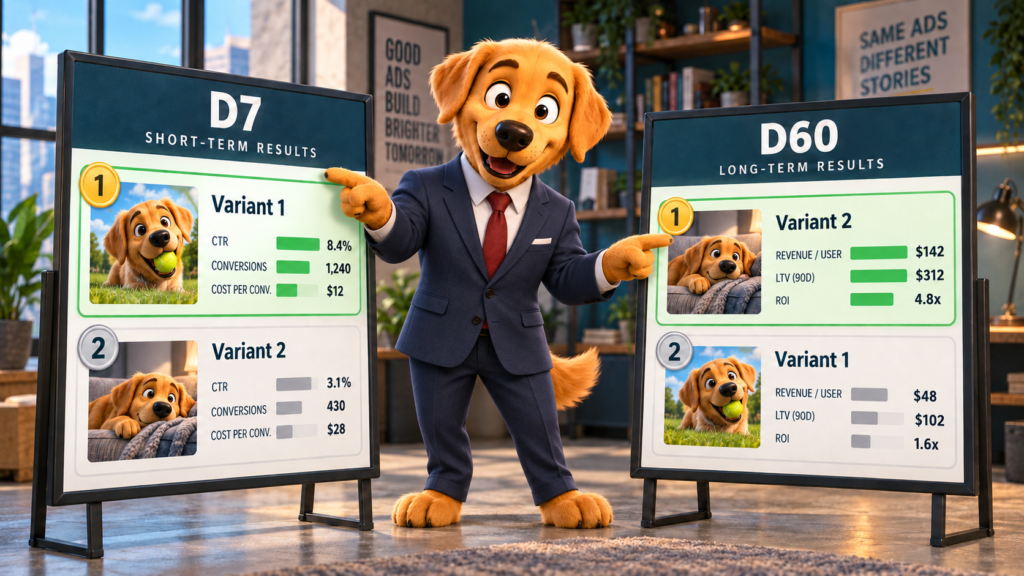
This is also why the common failure mode is so predictable. A team consolidates its ad sets because they read that consolidation wins, then feeds the algorithm five variations of the same concept and watches it kill four of them on early CTR signal. They conclude consolidation does not work. What actually happened is they brought a media buying decision to a creative problem and left the creative half unsolved. The algorithm did exactly what it was supposed to do. It just had nothing worth choosing between.
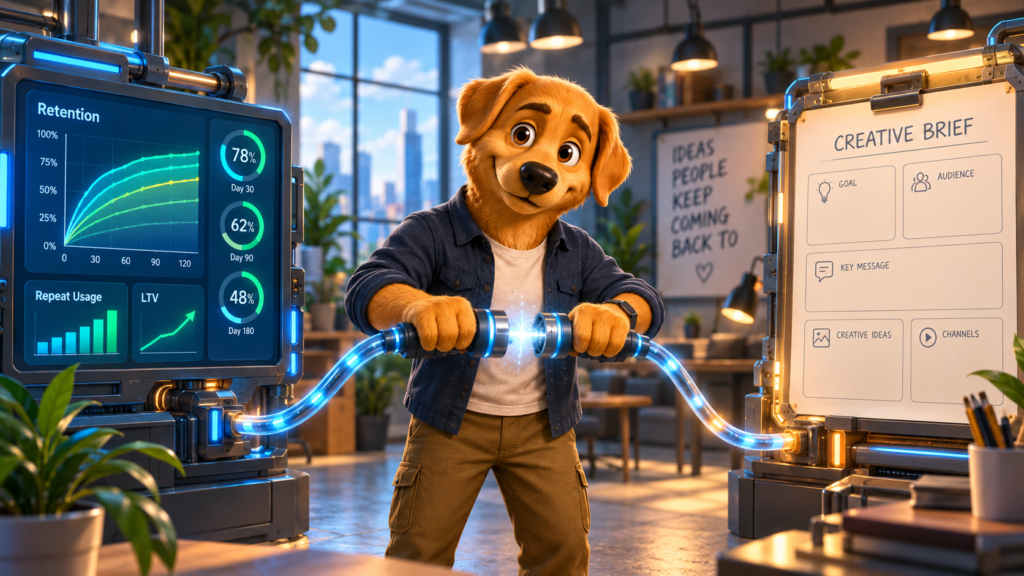
The teams winning the creative vs targeting shift are the ones running both sides as a single motion. The UA side builds the consolidated structure and manages the signal. The creative side feeds it a constant stream of distinct, well-tested concepts at the refresh cadence the algorithm rewards. When those two are one connected operation rather than two departments passing work back and forth, the whole thing compounds. When they are split, the seams show up directly in the CPA.
The creative vs targeting debate is settled, and the answer is not the one most buyers spent their careers believing. Targeting has been absorbed by algorithms that now read your creative to find your audience. The winning media buying move is to consolidate and feed clean signal. The winning creative move is to produce distinct concepts at volume and refresh them fast. And the reason those two have to move together is that the algorithm’s appetite for creative is created by the very consolidation that makes it perform.
Targeting is not where you win UA anymore. The account that wins is the one where a strong media buying structure and a high-volume creative pipeline are built as one system, because in 2026 they are two halves of the same lever.
If your creative and your media buying live in separate lanes and you suspect the seam is costing you, that is exactly the gap we close. Reach out and let’s get into it.