Every ad lives or dies in the first few seconds.
That has always been true, but the margin for error has gotten much smaller. Feeds move quickly, competition is intense, and users see a steady stream of game ads every day.
If the opening moment does not create curiosity, tension, or excitement immediately, the rest of the ad never gets a chance.
That is why the game ad hooks matter so much.
Most growth teams understand this in theory. They know the first few seconds are important. What many teams lack is a structured way to think about hooks.
Instead of testing random openings, it helps to treat hooks as a category system. Different types of hooks trigger different psychological reactions from players.
Once you understand those patterns, creative testing becomes much more intentional.
Hook engineering is simply the practice of designing the opening moment of an ad around a specific psychological trigger.
Instead of asking “What should this ad start with?”, the better question becomes “What emotion should the opening create?”
Curiosity.
Tension.
Envy.
Confidence.
Relief.
Each of these reactions can stop someone mid-scroll if executed well.
Over time, certain hook structures have proven especially effective for mobile games.
Below are some of the most reliable categories.
Spectacle hooks rely on visual impact.
The goal is to show something immediately impressive or unusual so the viewer pauses long enough to understand what they are seeing.
In mobile gaming, spectacle often comes from scale or intensity.
A massive chain reaction in a puzzle game.
An enormous boss fight.
A city collapsing during gameplay.
Hundreds of units battling on screen.
The key is immediacy. The spectacle needs to appear within the first moment of the ad, not halfway through.
When done well, spectacle creates curiosity. The viewer wants to understand how the moment happened.
Failure is surprisingly effective in game marketing.
Instead of showing a perfect victory, the ad opens with something going wrong.
A puzzle move fails.
A character falls into a trap.
A defense collapses.
A player makes the wrong decision.
This works because people naturally want to correct mistakes.
When viewers believe they could solve the situation better than the player in the ad, engagement increases.
Many puzzle and strategy games use this structure because it invites the viewer to mentally participate.
They begin solving the problem before the ad even finishes.
Closely related to failure hooks is the “almost won” moment.
Here, the player comes extremely close to success but falls short at the last second.
A tower defense survives until the final wave and then collapses.
A racing game loses in the final turn.
A puzzle is one move away from completion before time runs out.
This format creates tension and frustration at the same time.
The viewer instinctively thinks, “I could finish that.”
That thought is powerful because it positions the game as a challenge worth attempting.
Social proof works by signaling popularity or validation.
Instead of focusing purely on gameplay, the hook shows that other people are already enjoying the experience.
Examples include:
Large player counts
Competitive rankings
Friends playing together
High scores or leaderboards
When used carefully, social proof reduces hesitation. The viewer sees the game as something others are already invested in.
This category works especially well for multiplayer titles or competitive experiences.
Some games appeal to players who enjoy improving over time.
Skill hooks focus on mastery rather than spectacle.
The ad might open with a player performing a complex strategy or executing a difficult move with precision.
Instead of chaos, the viewer sees control.
These hooks tend to attract players who enjoy deeper gameplay systems.
They may not generate the highest install volume immediately, but they often bring in more engaged users who stay longer.
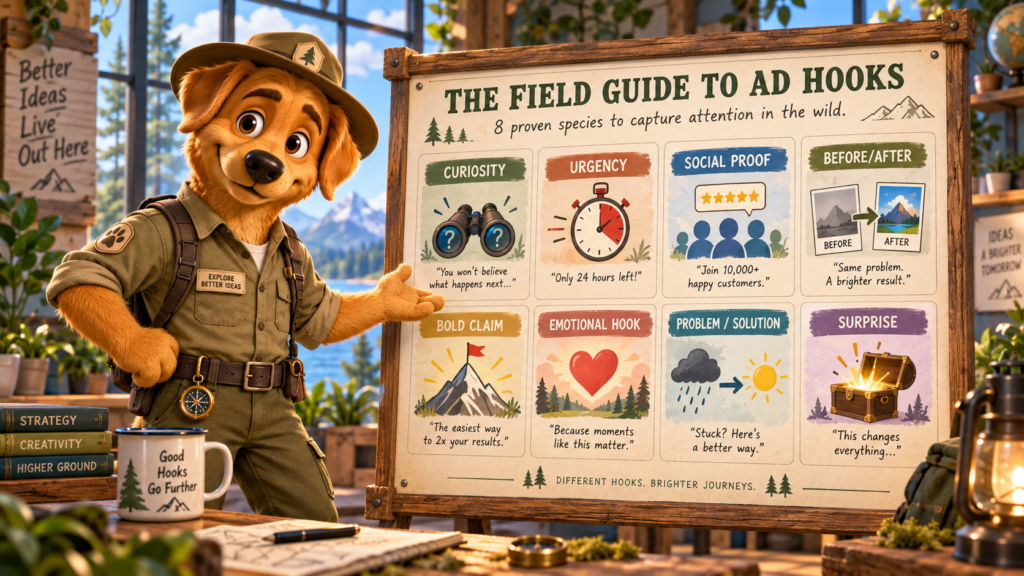
Curiosity is one of the most reliable ways to stop a scroll.
These hooks introduce something unusual or unexpected that the viewer wants explained.
A strange mechanic.
A surprising outcome.
A hidden feature revealed at the start.
The viewer sticks around to see how the moment resolves.
Curiosity hooks are especially useful when a game has a mechanic that looks different from typical genre expectations.
Not every hook category works equally well for every type of game.
Puzzle and casual titles often perform well with fail states and “almost won” moments.
Strategy and competitive games tend to benefit from mastery or social proof hooks.
Spectacle works best when the gameplay itself contains visually impressive moments.
The important part is testing these categories deliberately rather than randomly.
Instead of launching dozens of unrelated ads, teams can compare hook types directly.
Which trigger attracts the most engaged players?
Which hook produces stronger retention?
Which opening leads to deeper gameplay interaction?
Over time, patterns begin to appear.
Those patterns become the foundation of a stronger creative testing system.
Hook engineering does not replace the rest of the creative process.
Strong gameplay presentation, pacing, and messaging still matter.
But the opening moment determines whether viewers ever reach those parts.
In a crowded mobile market, attention is the most limited resource.
The teams that treat hooks as a design discipline rather than an afterthought usually gain an advantage.
Because once a hook stops the scroll, the rest of the ad finally has a chance to work.