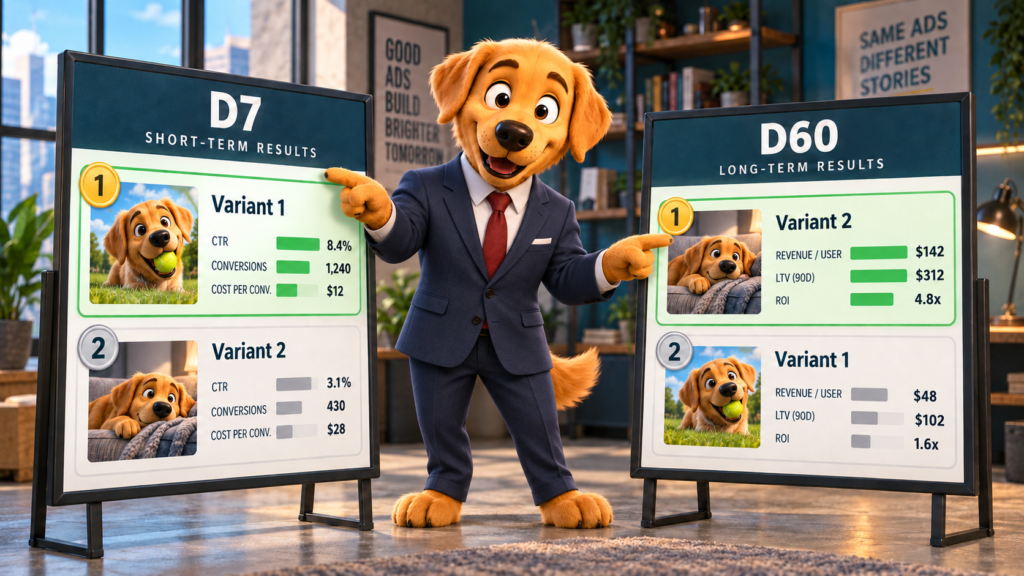
The retention feedback loop stops halfway at most companies. A campaign clears D60, the team notes it as a winner, and that’s where the process ends. Scale it, maybe brief a few more variants in the same vein, move on. The insight sits there, technically known, functionally unused, because nobody built the habit of feeding it back into how the next round of creative gets written.
Post 4 made the case that D7 alone gives an incomplete verdict, and D60 or D90 tells you something closer to the truth about which creative earns its budget. That’s half the argument. The other half, the part most accounts skip, is what happens once you have that longer read. A retention feedback loop means using what D60 reveals to shape the next hook, the next audience signal, the next brief. Not just deciding whether to keep spending on the ad that already ran. Without that loop, D60 data is just a more accurate scoreboard. With it, D60 data becomes the thing that makes next quarter’s creative better than this quarter’s.
The break happens for a boring reason. Retention data lives in analytics dashboards. Creative briefs live in a completely different tool, written by a different person, on a different schedule entirely. By the time D60 data is ready to look at, the creative team has moved three testing cycles past the campaign that data belongs to. Nobody’s ignoring the insight on purpose. It just arrives late enough that it no longer feels connected to anything currently in production.
There’s a second, less obvious reason. Retention data is aggregate and a little abstract. It tells you a cohort retained well. It doesn’t tell you which specific element of the ad, the hook, the framing, the visual style, deserves credit for that retention. Turning a retention number into a specific instruction for the next brief takes real interpretation, and that interpretation step is where the loop tends to die even when someone is genuinely paying attention to the data.
A third reason gets talked about less than the first two, and it’s mostly a staffing problem. Whoever owns retention analytics and whoever writes the creative brief are rarely the same person, and rarely even sit in the same meeting on a regular basis. Data gets reported up a chain. Briefs get written down a different chain. The two chains cross somewhere in a quarterly review deck, long after either of them could have acted on what the other one knew. A retention feedback loop needs those two chains to actually intersect somewhere closer to real time than a quarterly deck allows.
Closing it starts with asking a different question than most teams ask. Instead of “did this campaign work,” the question becomes “what kind of person did this campaign attract, and did that specific kind of person stick around.” That’s a subtler question, and it tends to have a more useful answer than a simple win or loss.
Say a hook built around competitive multiplayer footage clears D7 easily but shows mediocre D60 retention, while a hook built around a slower solo progression mechanic looks unremarkable at D7 and holds steady by D60. The obvious move is scaling the second hook. A closed loop goes further than that. It asks why. Maybe the competitive framing pulls in players looking for a quick multiplayer fix who lose interest once the matchmaking queue gets long. Maybe the progression framing pulls in players who want to sit with a game for a while, which happens to be exactly the kind of player this particular title rewards over time.
That answer becomes an instruction for the next brief, not just a scoreboard result. The next round of creative leans further into progression and pacing cues, tests variations on that specific theme, instead of treating the win as a one-off and moving on to some unrelated concept for the next test cycle.
This is where the loop matters for buying decisions too, and it’s worth being precise about what this does and doesn’t mean. This isn’t about running ads at the retained users themselves. It’s about using what made them retain well to inform who the platform’s own targeting system goes looking for next.
Meta’s Advantage+ and TikTok’s equivalent systems work off seed audiences and value-based signals, learning from whoever converts and whoever sticks around to find more people who look similar. Feed the algorithm nothing but “this person installed,” and the system has to guess at everything past that first action. Feed it retention data as part of the value signal, weighting toward users who stuck around rather than just users who tapped install, and targeting starts skewing toward better-fit audiences without anyone building a single retargeting campaign. The algorithm does that work well when the signal reflects what a genuinely good outcome looks like, rather than stopping at the install event and treating every install as equally valuable.
That’s a real distinction worth sitting with. Improving the signal fed into acquisition targeting is a completely different discipline from running ads at people who already left, even though both touch the word “retention” in casual conversation. One refines who the system goes after next. The other tries to win someone back after the fact. This series stays in the first lane, since that’s where a retention feedback loop actually pays off for an account built the way most gaming and iGaming accounts are structured.
A brief informed by a closed loop reads differently from one that only knows what won at D7. It carries a hypothesis, not just a format. Instead of “make three more variants of the winning ad,” it reads closer to “the last round showed pacing-focused hooks retaining better than combat-focused ones, test two more pacing angles and one hybrid to see where the ceiling sits.”
That’s a small shift in how a brief gets written, but it compounds fast. Each round of testing stops being an isolated bet and starts building on what the last round taught the account, which is really the whole promise of treating creative as a system instead of a string of disconnected guesses. Post 2 made that case about separating hooks from offers from proof points. This is the same argument applied across time instead of across a single ad’s components. The system doesn’t just organize one round of testing. It carries knowledge forward between rounds.
None of this requires a new department or a complicated dashboard build. What it requires is a standing point of contact between whoever owns retention data and whoever writes the next brief, on a cadence that matches how fast D60 data becomes available rather than how fast either team happens to meet already.
A simple version of this works fine to start. Once a month, whoever tracks retention pulls together which cohorts are holding up at D60, broken out by which creative brought them in. That gets handed to whoever’s writing briefs, not as a raw spreadsheet but as a short, plain-language summary: here’s what retained, here’s a guess at why, here’s what that might mean for the next round. The creative team doesn’t need to become data analysts, and the data team doesn’t need to become creative directors. They just need a monthly handoff that didn’t exist before.
The habit matters more than the tooling. A retention feedback loop built around a shared spreadsheet and a thirty-minute monthly call beats a sophisticated dashboard nobody checks. Start simple, and let the process get more automated once the habit is in place and everyone trusts that the handoff is worth their time.
Picture a casino app running two hook concepts for a new slot title. Hook one leads with a huge jackpot win animation, loud and immediate. Hook two leads with the game’s bonus round mechanic, a little more explanation required, less flashy on the surface. Hook one wins clearly at D7, better CPI, more installs. By D60, hook one’s cohort has mostly stopped playing, chasing a jackpot feeling the gameplay loop doesn’t deliver often enough to sustain daily use. Hook two’s smaller cohort is playing at nearly twice the rate, because those players came in already interested in the mechanic that keeps them coming back.
Without a closed loop, the team scales hook one, because it won the only number anyone bothered to look at. With the retention feedback loop closed, the next round of briefs leans into bonus round mechanics specifically, tests two or three variations on that theme, and feeds the platform’s targeting system a value signal weighted toward the players who kept playing rather than the ones who tapped install and vanished within a week. The account gets smarter one cycle at a time instead of chasing the same D7 spike over and over, quarter after quarter, with no memory of what it learned last time.
If your team is sitting on D60 data that never makes it back into how the next brief gets written, that’s usually the biggest untapped leverage in the account. Reach out and let’s look at what your retention data is telling you to build next.