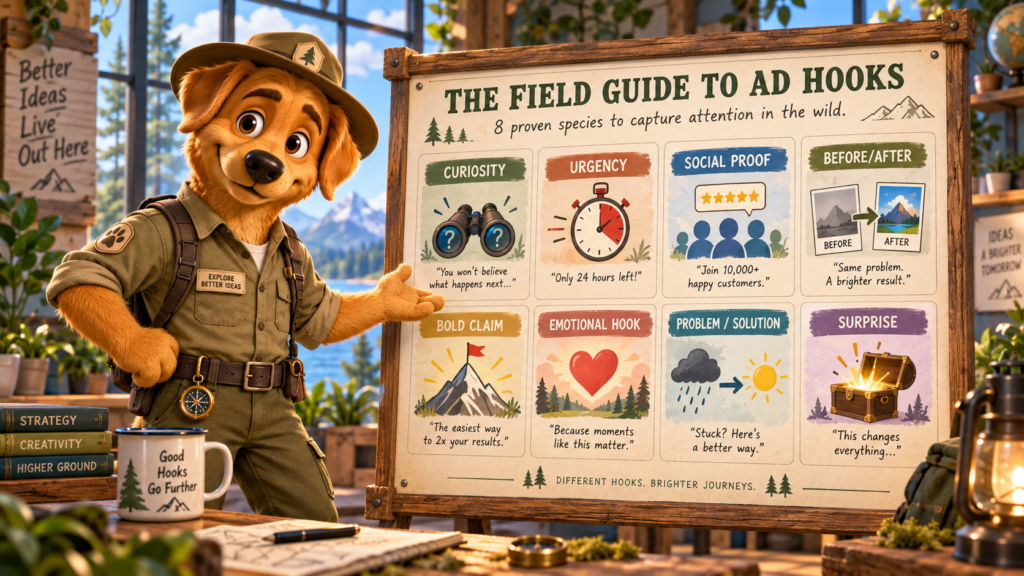
Hook archetypes exist whether or not anyone names them. Every ad opens with some version of the same handful of moves, dressed up differently game to game, vertical to vertical, but underneath it’s the same short list showing up over and over. Naming them doesn’t kill the magic. It just makes the pattern easier to spot, easier to brief, and a lot easier to talk about without pointing at a screen and saying “you know, like that one.”
Here’s the field guide. Eight hook archetypes, what makes each one tick, and where each one tends to fall apart. Knowing this list won’t write the ad for anyone, but it gives a creative team a shared vocabulary for talking about what’s working and why, which is more useful than it sounds once a brief actually needs to get written on a deadline.
Something happens in the first frame that doesn’t quite make sense yet. A character doing something backward, a number that looks wrong, an object where it shouldn’t be. The whole job of this hook is buying two extra seconds of attention while the brain tries to resolve the confusion, and mobile games lean on it constantly because two seconds is most of the battle.
The failure mode here is confusion with no payoff. If the weird thing never gets explained, or the explanation lands flat, the viewer feels a little tricked, and that feeling doesn’t do the brand any favors. The confusion has to resolve into something genuinely worth the setup, or it’s just a cheap trick wearing a clever costume.
A boss fight: one hit from failure. A poker hand that looks doomed until the river card flips. A puzzle piece placed at the absolute last second before the timer runs out. This one works because tension is a universal language, and nobody scrolls past a moment where something might genuinely go wrong.
It’s the workhorse of mobile gaming creative for a reason, and it’s also the most overused archetype on this whole list, which cuts both ways. Everyone knows it works, so everyone reaches for it, which means a near-loss hook now has to be genuinely well-executed to stand out in a feed full of other near-loss hooks fighting for the same three seconds.
Coins raining down. A number scrolling upward fast enough to feel unreal. The big win moment, filmed like it matters, because in a casino or slots context, it does. This one leans hardest into aspiration, showing the exact outcome the viewer wants for themselves before asking anything of them.
The trap here is promising something the actual gameplay can’t consistently deliver. A jackpot flex hook that pulls in players expecting constant big wins, when the real game is mostly modest, steady play, sets up the kind of retention mismatch a longer measurement window eventually exposes. Flashy and honest aren’t opposites, but they take real care to combine.
Camera in the player’s seat. Hands on the wheel, cards in your hand, the UI itself as the frame. This hook skips the step of watching someone else have fun and jumps straight to letting the viewer imagine themselves already playing. It’s a shortcut to identification that a third-person shot has to work much harder to earn.
Where it stumbles is genericness. A POV shot of a generic tap-to-match board looks like every other tap-to-match board from the driver’s seat. The perspective trick only pays off when there’s something specific enough underneath it worth seeing up close.
A character doing something obviously, almost comically wrong, followed by the correct or clever way to do it instead. Part tutorial, part comedy, this hook borrows from the internet’s endless appetite for watching someone fail before the fix arrives. It works especially well for puzzle and strategy games where there’s a genuine “aha” moment to deliver.
The risk is condescension. Played too smug, the viewer feels talked down to instead of let in on something clever, and that tone rarely survives contact with an audience that can tell the difference between playful and preachy in about half a second.
That one specific frustration everyone who’s played a certain kind of game recognizes instantly. The slot machine that teases with a near miss. The puzzle piece that’s obviously right but won’t fit. This hook opens on shared annoyance rather than aspiration, and shared annoyance is a surprisingly strong glue between a stranger and an ad.
It works best when the frustration is genuinely specific to the game, not a generic mobile gaming complaint that could belong to anything. The more precisely it names something a real player has actually felt, the harder it lands.
No dialogue, no voiceover, just oddly satisfying visuals. Tiles clicking into place. A perfectly executed combo. Cards shuffling in slow motion. This one leans on the same appeal as slime videos and pressure-washing clips, pure sensory satisfaction that needs zero context to land.
It’s a hard archetype to force. Some games genuinely have that satisfying visual moment built in, and for those, this hook is close to a cheat code. Games that don’t have one end up faking it, and a manufactured satisfying moment reads as manufactured almost immediately.
Borrowing the shape of whatever’s currently popular outside advertising entirely, a sound, a format, a meme structure, and pouring the game into it. This one moves fast and burns out fast, which is exactly the trade a team is making when reaching for it. High potential upside, short shelf life, and a real risk of feeling stale the moment the trend itself does.
It’s worth having in the toolkit specifically because it doesn’t compete with the other seven archetypes on this list. It’s not trying to be timeless. It’s trying to be right on time, which is its own legitimate skill.
Not every hook archetype fits every kind of game, and part of the craft is knowing which pairings tend to work before a single frame gets shot. Slot and casino titles lean naturally toward the jackpot flex and the near-loss, since both play directly into the emotional core of gambling itself, anticipation and payoff. Forcing a silent flex hook onto a slot game usually falls flat, because slots rarely have the kind of inherently satisfying visual mechanic that archetype depends on.
Puzzle and strategy games tend to pull the opposite way. The that’s-not-how-you-do-this hook and the wait, what hook both thrive here, because these genres are built around moments of realization, the instant a mechanic clicks into place in someone’s head. A near-loss hook can work too, but it has to be built around a genuinely strategic tension rather than a generic ticking clock, or it feels borrowed from a different kind of game entirely.
Social casino and bingo-style titles sit somewhere in between, often borrowing freely from both directions depending on the specific mechanic being highlighted that week. This is where a real library of hook archetypes pays off the most, since the flexibility to reach for whichever one fits the moment beats having one go-to move that gets forced onto every brief regardless of fit. A team that only knows two or three hook archetypes ends up briefing the same two or three ideas over and over, no matter what the game or the moment actually calls for.
None of this is a strict rulebook. Genre tendencies are a starting point for matching hook archetypes to a game, not a wall keeping a team from trying something unexpected. Some of the best-performing creative comes from an archetype nobody expected to work for that genre, executed well enough to earn the surprise.
Naming the archetype is the easy part. The actual craft is in the specific execution: which of these hook archetypes fits this specific game, this specific moment in a launch, this specific audience, and then building something inside that shape that doesn’t feel like it was pulled off a template. A near-loss hook built with real care beats a trend-jack built lazily every single time, and the reverse is just as true depending on what the moment calls for.
This is really the same argument the rest of this blog keeps circling back to from a different angle. The system matters, the testing matters, the data matters. None of it replaces the plain fact that somebody still has to come up with the idea, and knowing the shape of what’s worked before is one of the better starting points for figuring out what to build next. A field guide doesn’t replace the instinct to try something new. It just means the eighth idea in the room isn’t accidentally a worse version of the first one.
If your creative library is heavy on one or two hook archetypes and thin on the rest, that’s usually worth a look. Reach out and let’s talk through what might be missing from the mix.