Every year, someone declares that the game industry is “at a crossroads.”
In 2026, that statement finally feels accurate.
Not because games are dying. They’re not.
Not because creativity has slowed. It hasn’t.
But because the way games are built, funded, marketed, and grown is being re-examined all at once.
The State of the Game Industry report puts real numbers behind what many of us already feel. Layoffs have been painful. Budgets are tighter. Teams are smaller. Risk tolerance is lower. AI is everywhere and still controversial. Discovery is harder. Launches are more fragile.
So here’s the real question we should be asking heading into GDC:
Is the industry broken, or is it simply shedding bad habits?
At Work Dog Studios, we think it’s the second one.
And that’s why we’re heading to GDC optimistic, not cynical.
Let’s not sugarcoat it. The past couple of years have been rough.
Too much money chased too few proven ideas. Teams scaled before systems were solid. Growth was often assumed instead of earned. When the market corrected, people paid the price.
That hurts. And it matters.
But here’s the uncomfortable truth the industry is starting to face:
A lot of what got cut wasn’t creativity.
It was inefficiency.
Bloated pipelines. Unfocused UA. Creative that wasn’t tested early enough. Launch plans that assumed “the algorithm will figure it out.” Studio structures built for scale before traction.
The reset isn’t fun, but it is forcing better questions.
Those questions are finally being asked earlier, not after the burn rate spikes.
That’s a good thing.
Another GDC staple this year will be AI panic. And yes, some of it is justified.
The industry is right to be cautious. Creative theft, job displacement, environmental impact, and misuse are real concerns. No one should pretend otherwise.
But here’s the Work Dog take:
AI isn’t replacing great teams.
It’s exposing weak ones.
Used well, AI helps teams move faster on unglamorous work. It helps iterate, test, organize, and explore options. It gives small teams leverage.
Used poorly, it becomes a shortcut that strips out taste, originality, and accountability.
The studios that will win aren’t asking “How much AI can we use?”
They’re asking “Where does human judgment still matter most?”
That’s a far healthier conversation than the extremes.
One of the quiet shifts we see everywhere right now is how marketing is being treated.
It’s no longer a launch-only function. It’s no longer just “make some trailers and run ads.” And it definitely can’t survive on vibes and hope.
Teams are being forced to:
That pressure is uncomfortable for some studios. But it’s also long overdue.
The best teams we work with now treat creative and UA like product development. Hypotheses. Testing. Learning loops. Iteration.
That mindset doesn’t kill creativity. It protects it.
If everything can be shared on Discord, Slack, or Zoom, why does GDC still matter?
Because this is an industry built on trust, taste, and shared experience.
You don’t build that in comment threads.
GDC is where:
In a year where everyone is being more careful, those conversations matter more than ever.
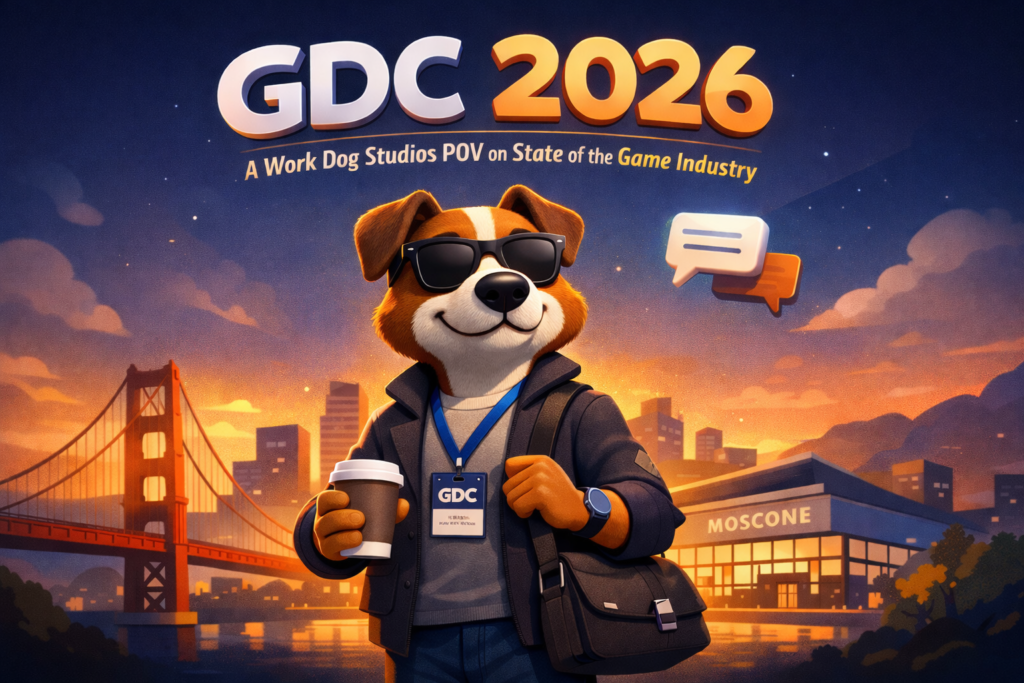
Work Dog Studios will be at GDC with a private meeting space adjacent to the Moscone Center.
We’re showing up because we believe the next phase of this industry will reward:
We want to hear what’s working for you.
What isn’t.
What you’re worried about.
What you’re excited to build next.
Sometimes the most valuable GDC meetings aren’t formal at all. They’re honest.
Despite everything, we’re optimistic.
People still love making games. Players still want great experiences. New platforms, formats, and audiences keep emerging. The tools are improving. The noise is forcing focus.
This isn’t the end of the industry.
It’s a recalibration.
And recalibrations, while painful, often lead to better work.
If you’re coming to GDC and want to connect, come see us or book time in our meeting space near Moscone. No pressure. No hard sell. Just a real conversation about where this industry is heading and how to build smarter within it.
We’ll be there. And we’re looking forward to it.