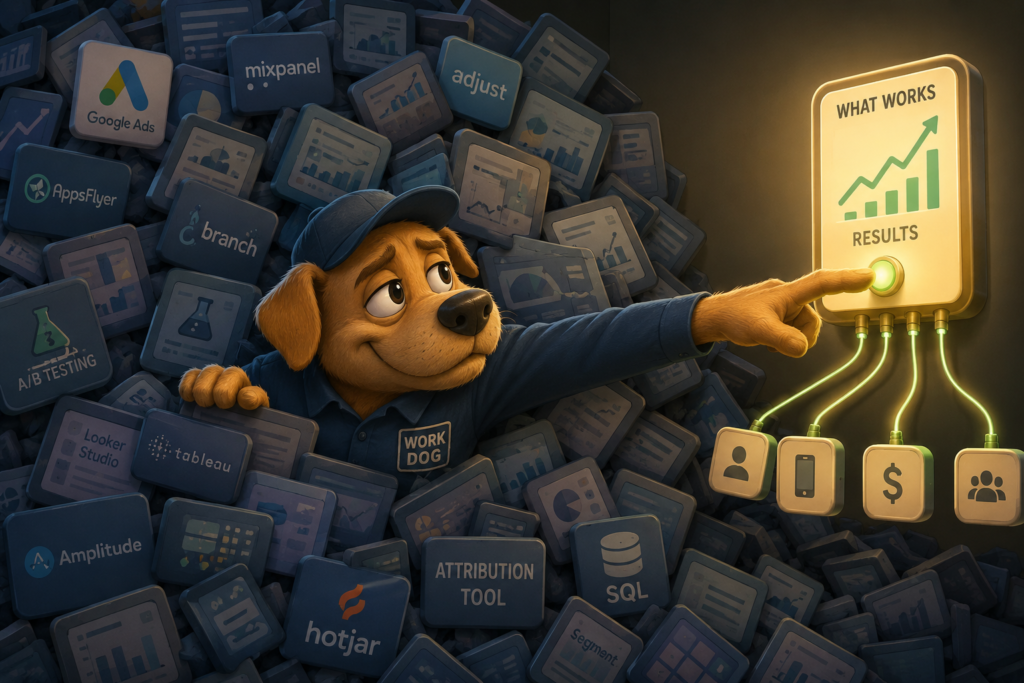
There is a reflex in marketing that says the answer to any problem is another tool. Attribution is murky? Buy an attribution platform. Creative testing is slow? Buy a testing suite. Data is messy? Buy a CDP. The martech stack grows, the logic goes, and the results grow with it.
The data says the opposite is happening. More marketing tech is not producing better results. It is producing bigger bills and thinner output.
Here is the number that ends the argument. Gartner’s Marketing Technology Survey puts stack utilization at just 33% of purchased capability, down from 42% in 2022 and 58% in 2020. Six straight years of decline. The average enterprise now runs somewhere between 80 and 91 tools and actively uses fewer than 40% of them. Roughly half of every dollar spent on marketing tech generates no active output at all. The stack got bigger every year and the results got worse. That is the myth, dead on arrival, and it is worth seeing why from the media buying side and the creative side both.
The myth treats tools like horsepower. More tools, more power, more output. The data shows tools behaving like clutter instead. Past a certain point, each new one adds cost, integration work, and another place for your data to get stranded, while adding almost nothing to what you actually produce.
Look at what the buying spree bought. The martech landscape now holds more than 15,000 tools, up from about 150 in 2011. Enterprises kept pace by stacking dozens of them, and utilization fell throughout. That is the tell. If more tools produced better results, utilization and output would climb together. Instead, spend went up while usage went down, which means the tools were never the driver of results. They were the thing draining the budget that could have.
The reason is simple. A tool does nothing on its own. It needs clean data feeding it, a person who knows how to run it, and a process that turns its output into a decision. Buy the tool without those three things, and you have not added a capability. You have added a subscription. Most stacks are full of tools nobody has fully operationalized, bought at different moments by different people for different jobs, none of them talking to each other. That is not a capability stack. That is a graveyard with a monthly invoice.
From the buying chair, the martech myth fails on a single hard truth. A sophisticated tool fed bad data gives you sophisticated bad answers, faster and with more confidence.
This is the trap underneath the whole stack. Teams buy an attribution platform or a fancy analytics suite hoping it will fix a measurement problem. But the tool does not fix the data. It processes whatever it is given. Feed it fragmented, half-integrated, siloed data, which is exactly what an 80-tool stack produces, and it hands you a beautiful dashboard built on garbage. The higher resolution just makes the wrong answer look more trustworthy.
The numbers say most teams are stuck right here. Only 22% of CMOs have a clear integration roadmap for the AI tools they are buying. One platform owns the lead record, another owns behavior, another claims attribution, and nobody owns the full signal chain. So insights never reach the systems that would act on them. The expensive tool runs in a corner, producing output nobody trusts enough to bet budget on. Meanwhile, 74% of marketing leaders cannot even quantify the ROI of their AI investments beyond surface-level metrics.
The move that actually works is the opposite of the myth. Fewer tools, deeper integration, clean data underneath. The 15% of organizations that qualify as martech high performers consistently run leaner stacks with stronger data integration, not bigger portfolios of loosely connected point solutions. The buyers winning in 2026 are auditing what they own, cutting anything with low adoption or duplicate function, and asking one question of every tool: what would break if we canceled it tomorrow? When the honest answer is nothing, that tool is draining budget every month for no reason.
From the creative chair, the myth falls apart on contact, because the thing that actually makes creative work is not something you can buy a license for.
Tools can generate variations, resize assets, tag creative, and serve it at scale. Useful work, all of it. What no tool does is have the idea. The hook that stops a thumb, the concept a person remembers, the reason someone cares, none of that comes out of a subscription. A team drowning in creative tools but short on creative thinking will produce a high volume of forgettable ads very efficiently. The tools did their job. There was just nothing worth scaling.
This is where the stack becomes a distraction from the actual work. Every hour spent evaluating, integrating, and babysitting another AI creative tool is an hour not spent on the concept, the brief, the thing that determines whether any of it performs. The 82% of marketers buried in manual work do not need a fourteenth tool. They need the tools they have to stop generating busywork so they can get back to thinking. More tech does not free up that time. It usually eats more of it.
The teams that win treat tools as leverage on a strong idea, never as a substitute for one. A great concept run through a lean, well-integrated toolset beats a mediocre concept run through the most expensive stack money can buy. The auction does not reward the size of your martech budget. It rewards the quality of what you put in front of a person, and quality starts in a human head, not a software catalog.
Put the two together, and the myth is exposed. Results do not come from the number of tools. They come from clean data, strong ideas, and a tight process that connects the two, and none of those three things is something you can buy off a shelf.
Here is the honest way a stack should work. The data layer is unified and clean, so every tool is working from the same truth. The toolset is lean, integrated, and actually used, so it generates leverage rather than invoices. And the humans supply the two things no tool can: the strategy that decides what to measure and why, and the creative idea that decides what to make. The tools are the multiplier. The ideas and the data are the things being multiplied. Multiply a strong input, and you get results. Multiply nothing, and you get a very expensive nothing.
This only works when creative and media share the same clean stack, rather than each hoarding their own. When the creative team’s testing data and the media team’s performance data live in separate, unintegrated tools, neither side sees the full picture, and both make worse calls. When they run on one integrated foundation, the creative learnings feed the media decisions, the media signals feed the creative brief, and the whole loop gets smarter. That integration is worth more than any single tool in the stack, and it is exactly what adding more tools tends to destroy.
More marketing tech does not mean better results. Utilization has fallen for six straight years, even as stacks have ballooned past 80 tools, which means the buying spree was never the driver of performance. A tool with no clean data, no operator, and no process attached is a subscription, not a capability.
The buying move is fewer tools, deeper integration, and clean data underneath, because a fancy tool fed bad data just gives you confident wrong answers. The creative move is to remember that no tool has an idea, and the idea is what actually wins. Run a lean, integrated stack shared across creative and media, feed it clean data and strong concepts, and the tools finally do what the myth promised. Keep buying tools to paper over the gaps, and you just automate the waste at a higher monthly rate.
If your stack keeps growing while your results flatten, the problem is not the tool you are missing. It is the one you already have. That is exactly what we help sort out. Reach out and let’s get into it.